
DANA Adam: 633 litres in Pego and a rainfall record in Ibiza
More than 630 litres per square metre fell in Pego, almost 576 in Oliva — and Ibiza Airport set a new 24-hour rainfall record.

Text size
Line spacing
DANA Adam brought extraordinary rainfall to eastern Spain on Sunday and Monday. Official AEMET measurements reveal more than 630 litres per square metre in Pego, almost 576 litres in Oliva and a new 24-hour precipitation record at Ibiza Airport. Severe flooding, emergency evacuations and the deployment of Spain's Military Emergencies Unit underline the seriousness of the weather event.
DANA Adam produced intense and persistent precipitation, particularly along the Mediterranean coast, affecting communities in the provinces of Alicante and Valencia as well as the Balearic Islands.
The consequences were serious: widespread flooding, inundated roads and residential areas, emergency evacuations and difficult conditions for rescue services.
The official rainfall measurements published by Spain's national meteorological agency, AEMET, demonstrate just how extreme the event became.
According to AEMET's daily precipitation observations:
To put that figure into perspective, 633 mm of rainfall corresponds to a water depth of more than 63 centimetres if all the precipitation remained in one place without draining away.
In reality, water flows downhill, collects in low-lying areas and enters rivers, streams and drainage systems.
When such enormous quantities of rain fall within a relatively short period, the resulting runoff can rapidly overwhelm drainage capacity and create dangerous flash-flood conditions.
The exceptional rainfall around Pego illustrates the destructive potential of a slow-moving or repeatedly developing thunderstorm system.
AEMET recorded:
Pego and Oliva are geographically close, and the extraordinary rainfall totals at both stations show how severely this section of Spain's Mediterranean coast was affected.
Further north, Miramar recorded 574.2 mm across the same two days, according to AEMET's daily observations.
These figures demonstrate that the extreme precipitation was not limited to a single weather station.
Roads and residential areas were inundated, with rising water levels creating dangerous conditions and leaving people in need of assistance.
Emergency evacuations were carried out, including operations involving helicopters to reach people isolated by floodwater.
Spain's Military Emergencies Unit (UME) was also involved in the emergency response, supporting efforts in areas affected by the flooding.
The situation demonstrates how quickly extreme rainfall can turn into a serious emergency, particularly in areas where large quantities of water converge in a short period.
Even after the heaviest precipitation ends, flooded roads, saturated ground and accumulated runoff can remain dangerous.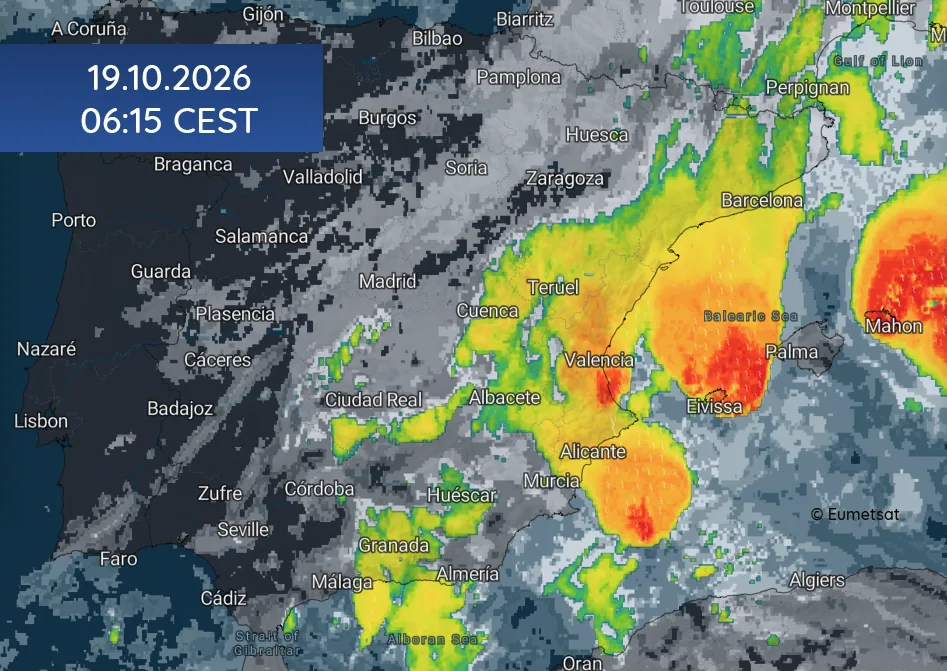
According to AEMET, the weather station at Ibiza Airport measured 173.8 mm of precipitation in a 24-hour period on 18 October 2026.
This is an absolute 24-hour rainfall record for the station, the highest recorded since observations began in 1944.
That makes it an exceptional event in the airport's more than 80-year measurement history.
AEMET's daily precipitation tables also show the following figures for Ibiza Airport:
The record refers to a specific 24-hour observation period, while the daily precipitation table uses separate reporting intervals. Different observation periods can therefore produce different totals without any contradiction.
The record at Ibiza Airport illustrates that DANA Adam affected not only mainland Spain but also the Balearic Islands.
Source: AEMET daily precipitation observations for 18 and 19 October 2026. Combined totals calculated by meteo365.es.
Additional AEMET record: Ibiza Airport measured 173.8 mm within a 24-hour observation period on 18 October, establishing a new station record since measurements began in 1944.
All rainfall amounts are expressed in millimetres. One millimetre of precipitation is equivalent to one litre of water per square metre.
Such systems can create significant atmospheric instability, particularly when cold air aloft interacts with warm, moisture-rich air over the Mediterranean region.
Under favourable conditions, powerful thunderstorms can develop and produce very intense precipitation.
One of the greatest dangers occurs when showers and thunderstorms repeatedly affect the same area.
Instead of moving quickly away, successive areas of precipitation may pass over the same communities, causing rainfall totals to accumulate rapidly.
Local geography can further intensify precipitation, particularly where moist air is forced to rise over coastal mountain ranges.
However, a DANA does not automatically mean catastrophic weather. Its effects depend on the atmospheric conditions, available moisture, storm movement and local terrain.
In the case of DANA Adam, the exceptional rainfall totals measured by AEMET show just how intense the resulting precipitation became.
For residents in the affected areas, DANA Adam meant flooded streets, damaged properties, disrupted daily routines and serious concerns for personal safety.
The helicopter evacuations and deployment of emergency personnel highlight the challenges faced during the most dangerous phases of the storm.
Our thoughts are with everyone affected by the flooding.
We also recognise the dedication of the firefighters, rescue teams, emergency services and military personnel who worked to protect lives and assist communities during this exceptional weather event.
During severe weather, always follow official warnings and instructions from emergency services and local authorities. Never attempt to cross flooded roads or waterways.
Sources: AEMET official precipitation observations and station records; meteo365.es meteorological analysis.
meteo365.es — Weather you can understand. Information you can trust.
Two days of exceptional rainfall in Spain
Sunday, 18 October, and Monday, 19 October 2026, brought an extraordinary episode of severe weather to parts of Spain.DANA Adam produced intense and persistent precipitation, particularly along the Mediterranean coast, affecting communities in the provinces of Alicante and Valencia as well as the Balearic Islands.
The consequences were serious: widespread flooding, inundated roads and residential areas, emergency evacuations and difficult conditions for rescue services.
The official rainfall measurements published by Spain's national meteorological agency, AEMET, demonstrate just how extreme the event became.
Pego: 633.2 litres per square metre in two days
One of the most remarkable rainfall totals was recorded in Pego, in Alicante province.According to AEMET's daily precipitation observations:
- Sunday, 18 October: 168.0 mm
- Monday, 19 October: 465.2 mm
- Combined total: 633.2 mm
To put that figure into perspective, 633 mm of rainfall corresponds to a water depth of more than 63 centimetres if all the precipitation remained in one place without draining away.
In reality, water flows downhill, collects in low-lying areas and enters rivers, streams and drainage systems.
When such enormous quantities of rain fall within a relatively short period, the resulting runoff can rapidly overwhelm drainage capacity and create dangerous flash-flood conditions.
The exceptional rainfall around Pego illustrates the destructive potential of a slow-moving or repeatedly developing thunderstorm system.
Oliva: almost 576 litres per square metre
The situation was similarly extreme in Oliva, in the neighbouring province of Valencia.AEMET recorded:
- Sunday, 18 October: 165.9 mm
- Monday, 19 October: 410.0 mm
- Combined total: 575.9 mm
Pego and Oliva are geographically close, and the extraordinary rainfall totals at both stations show how severely this section of Spain's Mediterranean coast was affected.
Further north, Miramar recorded 574.2 mm across the same two days, according to AEMET's daily observations.
These figures demonstrate that the extreme precipitation was not limited to a single weather station.
Severe flooding and emergency operations
The exceptional rainfall resulted in major flooding across affected communities.Roads and residential areas were inundated, with rising water levels creating dangerous conditions and leaving people in need of assistance.
Emergency evacuations were carried out, including operations involving helicopters to reach people isolated by floodwater.
Spain's Military Emergencies Unit (UME) was also involved in the emergency response, supporting efforts in areas affected by the flooding.
The situation demonstrates how quickly extreme rainfall can turn into a serious emergency, particularly in areas where large quantities of water converge in a short period.
Even after the heaviest precipitation ends, flooded roads, saturated ground and accumulated runoff can remain dangerous.
Ibiza Airport: a historic rainfall record since 1944
DANA Adam also brought exceptional rainfall to the Balearic Islands.According to AEMET, the weather station at Ibiza Airport measured 173.8 mm of precipitation in a 24-hour period on 18 October 2026.
This is an absolute 24-hour rainfall record for the station, the highest recorded since observations began in 1944.
That makes it an exceptional event in the airport's more than 80-year measurement history.
AEMET's daily precipitation tables also show the following figures for Ibiza Airport:
- Sunday, 18 October: 123.5 mm
- Monday, 19 October: 75.9 mm
- Combined daily totals: 199.4 mm
The record refers to a specific 24-hour observation period, while the daily precipitation table uses separate reporting intervals. Different observation periods can therefore produce different totals without any contradiction.
The record at Ibiza Airport illustrates that DANA Adam affected not only mainland Spain but also the Balearic Islands.
Official rainfall observations at a glance
The following table summarises selected measurements for Sunday, 18 October, and Monday, 19 October 2026.| AEMET weather station | Sun 18 Oct | Mon 19 Oct | Combined total |
|---|---|---|---|
| Pego, Alicante | 168.0 mm | 465.2 mm | 633.2 mm |
| Oliva, Valencia | 165.9 mm | 410.0 mm | 575.9 mm |
| Miramar, Valencia | 203.2 mm | 371.0 mm | 574.2 mm |
| Ibiza Airport | 123.5 mm | 75.9 mm | 199.4 mm |
| Eivissa | 68.4 mm | 83.4 mm | 151.8 mm |
Additional AEMET record: Ibiza Airport measured 173.8 mm within a 24-hour observation period on 18 October, establishing a new station record since measurements began in 1944.
All rainfall amounts are expressed in millimetres. One millimetre of precipitation is equivalent to one litre of water per square metre.
Why did DANA Adam produce such intense rainfall?
A DANA — Depresión Aislada en Niveles Altos — is an isolated low-pressure system at higher levels of the atmosphere.Such systems can create significant atmospheric instability, particularly when cold air aloft interacts with warm, moisture-rich air over the Mediterranean region.
Under favourable conditions, powerful thunderstorms can develop and produce very intense precipitation.
One of the greatest dangers occurs when showers and thunderstorms repeatedly affect the same area.
Instead of moving quickly away, successive areas of precipitation may pass over the same communities, causing rainfall totals to accumulate rapidly.
Local geography can further intensify precipitation, particularly where moist air is forced to rise over coastal mountain ranges.
However, a DANA does not automatically mean catastrophic weather. Its effects depend on the atmospheric conditions, available moisture, storm movement and local terrain.
In the case of DANA Adam, the exceptional rainfall totals measured by AEMET show just how intense the resulting precipitation became.
Behind the numbers are communities affected by flooding
The figures are extraordinary, but rainfall statistics tell only part of the story.For residents in the affected areas, DANA Adam meant flooded streets, damaged properties, disrupted daily routines and serious concerns for personal safety.
The helicopter evacuations and deployment of emergency personnel highlight the challenges faced during the most dangerous phases of the storm.
Our thoughts are with everyone affected by the flooding.
We also recognise the dedication of the firefighters, rescue teams, emergency services and military personnel who worked to protect lives and assist communities during this exceptional weather event.
Understanding extreme weather with meteo365.es
DANA Adam is another reminder of why accessible, reliable and clearly explained weather information matters.Our radar view is prepared from the official radar data of AEMET and the other national weather services; our own NowCast adds the expected short-term movement of the precipitation, while our weather maps help explain the wider meteorological situation.During severe weather, always follow official warnings and instructions from emergency services and local authorities. Never attempt to cross flooded roads or waterways.
Sources: AEMET official precipitation observations and station records; meteo365.es meteorological analysis.
meteo365.es — Weather you can understand. Information you can trust.


